
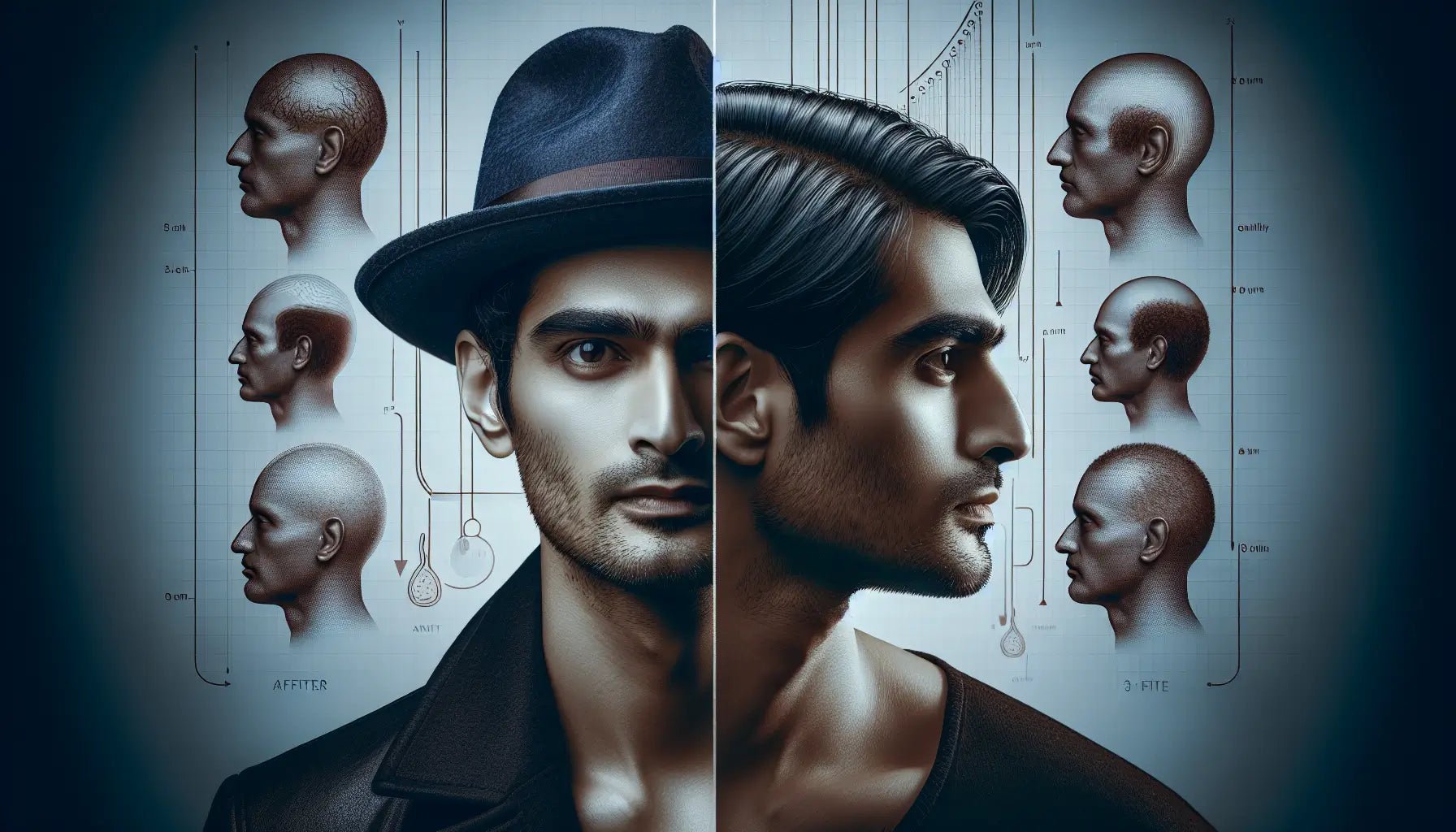
Short answer: no. Wearing a hat does not cause hair loss. No good study has ever shown that hats make you go bald. In fact, the largest study on identical twins found the opposite of what most people expect.
But that is not the whole story. Hats can affect your hair in a few smaller, indirect ways. Most people worry about the wrong one.
This guide covers what the research actually says, the one real risk worth knowing about, and the overlooked link between hats and shedding that almost nobody talks about.
Why people think hats cause baldness
The myth is old and it sticks around for three simple reasons.
- Timing. Many men start wearing caps daily in their twenties. That is the same decade pattern hair loss usually begins. Two things happening together is not one causing the other.
- Hat hair. When you take a hat off, your hair is flattened against your scalp. It looks thinner. That look is temporary and has nothing to do with losing hair.
- Loose hairs in the hat. You see strands inside your cap and assume the hat pulled them out. Those hairs were already shed. You would find them on your pillow and in the shower drain too.
There is also a belief that your scalp needs to breathe. This one is worth clearing up properly, because it is the root of the whole myth.
Your hair follicles do not breathe air
Hair follicles sit deep in the skin. They get oxygen and nutrients from tiny blood vessels underneath, not from the air around your head.
Covering your scalp with a hat does not suffocate anything. There is no airflow your follicles are missing out on.
The same goes for blood flow. A hat would have to be tight enough to be painful before it restricted circulation to the scalp, and even then the follicles sit too deep for normal hat pressure to reach them.
So the two most common explanations for the myth are both wrong.
What the twin studies actually found
This is where it gets interesting, and where a lot of articles get it backwards.
Researchers at Case Western Reserve University ran two studies on identical twins. Identical twins share the same DNA, so any difference in their hair points to lifestyle rather than genes. That makes this a genuinely useful way to test the question.
The male study looked at 92 identical male twins (Gatherwright and colleagues, published in Plastic and Reconstructive Surgery, 2013). Daily hat use was associated with less hair loss at the temples, not more.
The female study looked at 98 identical female twins. In that group, not wearing a hat was linked to increased hair loss.
Nobody should read this as proof that hats grow hair. They do not. These are observational findings, and the likeliest explanation is sun protection. Covering your scalp shields it from ultraviolet damage.
What the studies do show clearly is that hat use was not a risk factor for hair loss in either group.
The same male study did find two things that mattered a great deal. Longer smoking history was strongly linked to frontal hair loss. And the presence of dandruff was significantly linked to it as well. Hold on to that second one, because it leads to the part most articles skip.
The one real risk: traction alopecia
Traction alopecia is hair loss caused by constant pulling on the roots. It is usually associated with tight braids, tight ponytails and hair extensions.
Headwear can do it too, but only under specific conditions:
- The item is genuinely tight, not just snug
- It is worn for many hours at a stretch
- It is worn that way most days, over months or years
A baseball cap you wear for a few hours at the weekend will not do this. The risk sits with headwear worn tightly for most of the waking day.
One survey of women who wear a hijab found that among those wearing it for seven to nine hours a day, about a third reported hair loss. The important detail is not the garment. It is the tension and the duration.
The good news is that traction alopecia is reversible in its early stages. Loosen the tension and the hair usually recovers. If it goes on for years, the follicles can scar and the loss becomes permanent. That is why catching it early matters.
Early signs to watch for:
- Thinning right along the hairline or wherever the band sits
- Small bumps or tenderness in that same band
- Short, broken hairs at the edges
- A headache or sore feeling after taking the hat off
The overlooked link: hats, sweat and dandruff
This is the part competitors tend to miss, and it is better supported than the blood flow story everyone repeats.
A hat traps heat and moisture against your scalp. A warm, damp scalp is a good environment for Malassezia, the yeast behind dandruff and seborrhoeic dermatitis.
Here is why that matters. Dandruff is not just a cosmetic annoyance. Research has repeatedly linked scalp inflammation to increased shedding, a pattern known as telogen effluvium, where more hairs than usual drop into the resting phase and fall out.
Remember the twin study. Dandruff was one of only two lifestyle factors significantly associated with frontal hair loss.
So the honest chain looks like this:
Hat traps sweat and oil, scalp gets inflamed and flaky, inflammation increases shedding
Note what this is not. The hat is not causing pattern baldness. It is not shrinking your follicles. This kind of shedding is usually temporary and it settles once the scalp calms down.
It also has an easy fix, which is more than can be said for genetics:
- Wash your hats. Sweat, oil and skin cells build up in the band. Most cotton caps can go in the wash.
- Do not put a hat straight onto a wet head. Damp plus warm plus covered is the worst combination.
- Give your scalp hat-free hours, especially in warm weather.
- Treat flaking early rather than ignoring it. Our guide on how to treat a flaky scalp walks through the basics.
Hat hair or hair loss? How to tell them apart
Most people who worry about this are actually looking at hat hair. Here is how to check.
| Sign | Hat hair | Real hair loss |
|---|---|---|
| How fast it appears | Instantly, when the hat comes off | Slowly, over months |
| Does it fix itself? | Yes, after washing or a few hours | No |
| Scalp visibility | Only where the hair is pressed flat | Widening parting or thinning crown |
| Pattern | Follows the shape of the hat band | Follows temples, crown or parting |
| Hair thickness | Unchanged | Individual strands get finer |
A simple test: take a photo of your parting in the same light once a month. Flattened hair looks different day to day. Genuine thinning shows up as a slow trend across those photos.
Losing roughly 50 to 100 hairs a day is normal. Seeing some in your hat is expected.
Hard hats and helmets
This comes up a lot, and the answer is slightly different.
A study of military headwear found no link to hair loss. But hard hats and motorcycle helmets raise two issues that a cotton cap does not:
- Long wear time. A full working day, five days a week, is exactly the duration that matters for traction.
- Heat and moisture. Hard hats and helmets trap far more sweat than a fabric cap, which feeds straight into the dandruff problem above.
Practical steps if you wear one for work:
- Adjust the suspension harness so the weight sits on the crown, not clamped around the sides
- Use a moisture-wicking liner and wash it often
- Take it off during breaks to let the scalp dry
- Avoid tying long hair tightly under the helmet, as that stacks tension on tension
Beanies and winter hats
Beanies get singled out because they grip the head all the way round and are often worn indoors for hours.
Two things worth knowing:
- Wool and synthetic knits create more friction than smooth cotton. Friction breaks hair shafts. That is breakage, not root-level loss, but it still thins the look of your hair.
- A beanie pulled on and off repeatedly will collect loose hairs that were shedding anyway.
If you wear beanies daily, a smooth lining reduces friction considerably.
Does wearing a hat slow hair growth?
No. Hair growth speed is set by the follicle, and follicles are fed by your bloodstream, not by air contact.
Your hair grows at roughly the same rate whether it is covered or not. If your hair seems to be growing slowly, the cause is far more likely to be breakage at the ends, nutrition, or a disruption to the growth cycle. We cover this in more detail in why has my hair stopped growing.
What actually causes hair loss
If you are losing hair, the cause is almost certainly on this list rather than in your wardrobe.
- Genetics. Androgenetic alopecia, or pattern hair loss, is by far the most common cause. It comes down to how sensitive your follicles are to DHT, a hormone derived from testosterone.
- Hormonal change. Pregnancy, childbirth, menopause and thyroid problems all shift the growth cycle.
- Stress and illness. A major physical or emotional event can push hairs into shedding, often two to three months later.
- Nutrition. Low iron, low protein and heavy calorie restriction all show up in your hair.
- Autoimmune conditions. Alopecia areata causes patchy loss and is unrelated to anything you wear.
- Medication and medical treatment. Including chemotherapy and some common prescriptions.
- Smoking. The twin study found longer smoking history strongly linked to frontal hair loss.
For a fuller breakdown of how the growth cycle works, see our guide to the science behind hair growth and loss.
How to wear hats without harming your hair
- Choose a hat you can fit two fingers under at the band. If it leaves a deep mark, it is too tight.
- Pick breathable materials. Cotton and linen let heat escape better than thick synthetics.
- Wash hats regularly, particularly the sweatband.
- Let your hair dry fully before covering it.
- Take the hat off during the day where you can.
- Do not pull a hat on over a tight ponytail or bun. That doubles the tension in one spot.
- Remove hats gently rather than dragging them off by the crown.
Keeping the scalp itself in good condition helps too. A lightweight leave-in like our Rosemary Rice Water Moisturising Spray can be used on the scalp and lengths without leaving hair greasy under a hat. To be clear about what this does and does not do: it supports scalp condition and reduces breakage. It will not reverse genetic hair loss, and no topical product will.
When to speak to a doctor
Book an appointment if you notice any of these:
- Shedding that stays heavy for more than three months
- Patchy bald spots rather than general thinning
- A visibly widening parting or receding hairline
- An itchy, sore or flaking scalp that has not improved after two to three weeks of an anti-dandruff shampoo
- Redness, pain or small bumps along your hairline
- Hair loss alongside tiredness, weight change or other symptoms
Hair loss treated early is much easier to slow than hair loss left for years. A doctor or dermatologist can identify the type, which matters because the treatments are completely different.
The bottom line
Wear your hat. It is not making you bald, and the best available evidence on identical twins suggests it may even protect the scalp from sun damage.
What is worth your attention is fit and hygiene. Keep it loose enough, keep it clean, and do not seal a damp scalp under it for hours. Those habits deal with the two genuine risks: tension on the roots and an inflamed, flaky scalp.
If your hair is thinning, the answer is almost certainly genetics, hormones, stress or nutrition. That is where to put your effort.
Frequently asked questions
Does wearing a hat every day cause hair loss?
No. Daily hat use has not been shown to cause hair loss. In a study of 92 identical male twins, daily hat use was actually associated with less hair loss at the temples. The things to watch with daily wear are fit and cleanliness, not frequency.
Can a hat make you go bald?
No. Baldness in men is caused by androgenetic alopecia, which is genetic and driven by follicle sensitivity to DHT. A hat cannot cause that. Very tight headwear worn for long hours can cause traction alopecia, which is a different condition and is reversible when caught early.
Do hats cause a receding hairline?
A receding hairline is usually pattern hair loss, which is hereditary. Hats do not cause it. However, headwear worn tightly across the front of the head for many hours a day can cause thinning along the hairline through tension.
Do hats cause dandruff?
A hat does not cause dandruff by itself, but it can make it worse. Trapping heat and sweat against the scalp creates conditions that suit the yeast behind dandruff. Washing your hats and avoiding covering wet hair both help.
Do hard hats cause hair loss?
Hard hats have not been shown to cause hair loss. Studies on military headwear found no link. The practical risks are the long hours and the sweat they trap. Adjust the harness so it is not clamping the sides of your head, and let your scalp dry during breaks.
Does wearing a hat slow hair growth?
No. Hair follicles receive oxygen and nutrients through the bloodstream, not from air reaching the scalp. Covering your head does not slow growth.
Why do I find hair in my hat?
Most likely because you are shedding normally. Losing 50 to 100 hairs a day is typical. Those hairs collect in your hat the same way they collect on your pillow and in the shower.
Is it bad to sleep in a hat or beanie?
It is not dangerous, but it is not ideal. Sleeping in a beanie means hours of friction and trapped heat with no break. If you want to protect your hair overnight, a smooth satin or silk cover creates far less friction than knitted wool.
Can hats cause traction alopecia?
Yes, but only in specific circumstances: headwear that is genuinely tight, worn for many hours a day, over a sustained period. Ordinary casual hat wear does not meet that threshold.